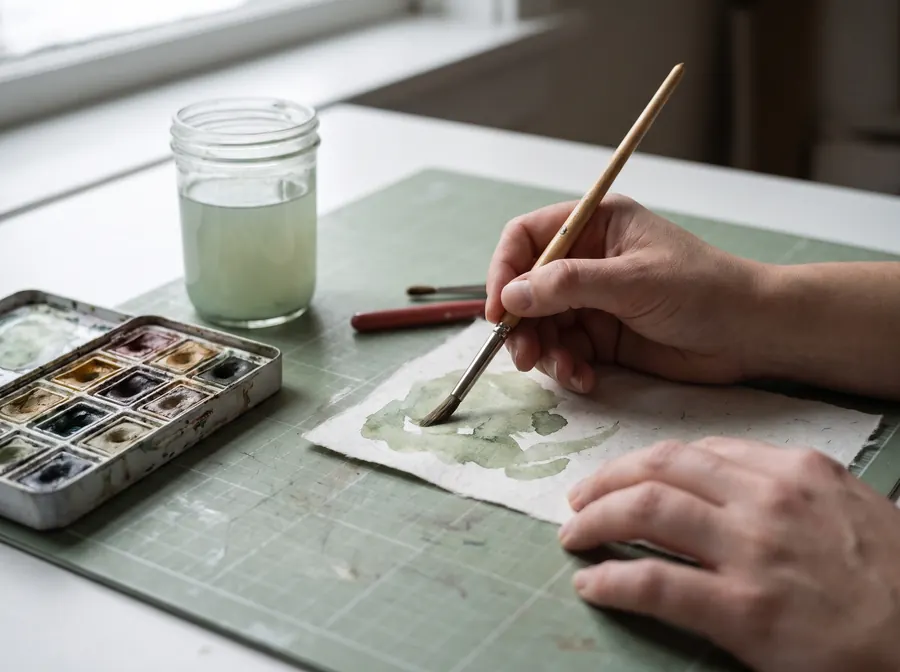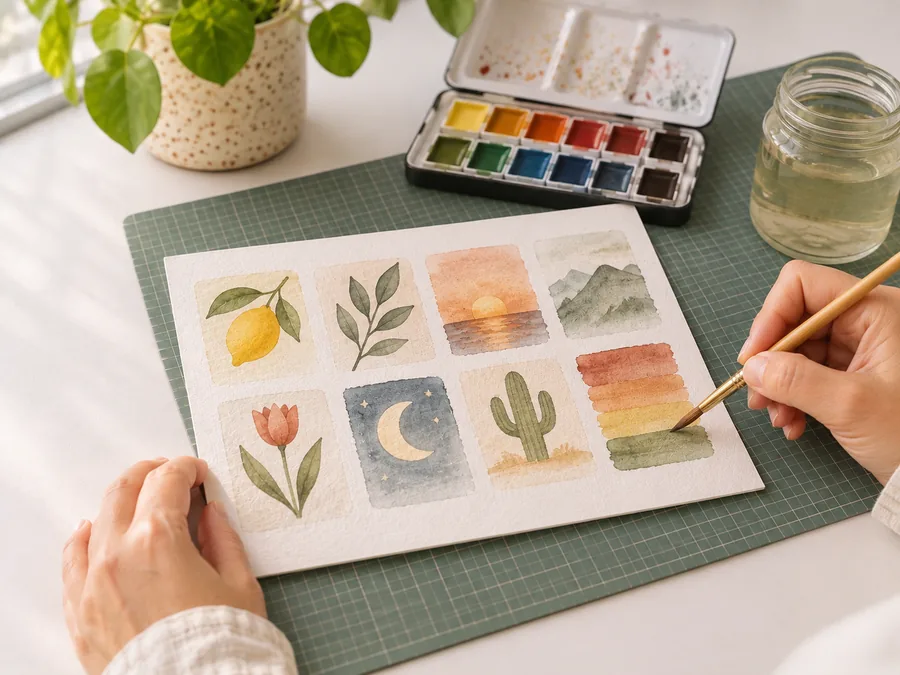
Most lists of watercolor ideas give you a pile of subjects: a galaxy, a sunflower, a fox. What they rarely tell you is which skill each painting practices, or what to paint first so the next one gets easier.
This list of easy watercolor ideas is sorted the other way around. The 20 paintings below are grouped by the three skills every beginner needs (washes, wet-on-wet and layering), and each group builds on the one before. The short answer: start with simple washes, move to wet-on-wet skies, and save layered subjects for last.
How should a beginner choose what to paint?
Choose by skill, not by subject. If a painting goes wrong, it is almost always because of water control: too much water, too little, or painting into a layer at the wrong moment. Practicing one skill at a time makes it obvious what went wrong.
A few rules make every idea below easier:
- Paint small. A postcard size, about 4 x 6 inches (10 x 15 cm), is enough. Small pieces dry faster and you can do several in one sitting.
- Tape the edges. Masking tape keeps the paper flat and leaves a clean border.
- Use two or three colors. Fewer colors means less mud and more attention on the water.
- Repeat ideas. Paint the same one twice in a row. The second version is where you start to see progress.
If you still need supplies, our watercolor supplies guide for beginners explains what to buy and where to save.
The three skills, and the order to learn them
| Skill | What it is | What it looks like | Learn it with |
|---|---|---|---|
| 1. Washes | Paint brushed onto dry paper in one even layer, or fading from dark to light | Smooth color fields, crisp edges | Ideas 1 to 7 |
| 2. Wet-on-wet | Paint dropped onto paper that is already damp | Soft, blurry edges, colors melting together | Ideas 8 to 14 |
| 3. Layering (glazing) | A transparent layer painted over a dry layer | Depth, shadows, overlapping shapes | Ideas 15 to 20 |
Washes come first because they teach you how much water and paint to load on the brush. Wet-on-wet adds timing. Layering adds patience, because it only works on fully dry paper.
Easy watercolor ideas with washes (ideas 1 to 7)
A wash is the basic watercolor move: a puddle of diluted paint pulled across the paper with the brush, working top to bottom so the wet edge never dries. Tilt the board slightly so the paint flows down.
- Color swatch chart. A grid of small squares, one per paint in your set. It teaches loading the brush, and you end up with a reference for every color.
- Ombre stripes. Three horizontal stripes, each fading from dark to light. Add a little more water with every stroke to make the fade.
- Simple sunset gradient. A single wash from yellow at the bottom to orange to pink at the top. Keep it as a background, or add a dark hill once it is dry.
- Geometric shapes. Triangles and squares painted one at a time, leaving white paper between them so they cannot bleed.
- Rainbow arcs. Seven curved bands, each painted when the previous one is dry or with a thin white gap between them.
- Bookmark strip. A long, narrow gradient on a scrap of paper. Practical, quick and a good way to use leftovers.
- Lemon or orange slice. A circle wash in yellow or orange, then a simple ring and segments painted with less water once it is dry.
Wet-on-wet ideas for soft, blended paintings (ideas 8 to 14)
Wet-on-wet means wetting the paper with clean water first, then touching in paint. The paper should be evenly damp with a soft sheen, not standing puddles. Too wet and the paint runs everywhere; too dry and you get hard edges.
- Blended color circles. Wet a circle shape, then drop in two colors from opposite sides and watch them meet.
- Soft sky with clouds. Wet the whole sky, drop in blue, then dab some away with a clean paper towel to leave white clouds.
- Night galaxy. Wet the paper, drop in dark blue, purple and a touch of pink. When it is dry, flick white paint or white gel pen dots for stars.
- Misty mountains. Wet the paper and paint a soft mountain shape in pale blue. The blurry edge reads as distance and fog.
- Abstract bloom. Drop lots of color into damp paper and let it spread on its own. A low-pressure way to learn how fast paint moves.
- Salt texture sky. Paint a wet wash, then sprinkle a little salt on it before it dries. Once it is completely dry, brush the salt off to reveal small starburst patterns.
- Ocean water. Wet the bottom half of the paper, drop in two blues and a green, and leave thin lines of white paper for wave highlights.
Layering ideas for depth (ideas 15 to 20)
Layering, also called glazing, means painting a transparent layer over one that is completely dry. The first layer shows through the second, which creates shadows and depth. If the paper still feels cool to the touch, it is still damp; wait.
- Overlapping circles. Paint three pale circles, let them dry, then overlap them with three more. Where they cross, you see the new color.
- Single leaf, then a branch. One pale green leaf shape, dry, then a darker vein and a shadow on one side. Repeat leaves along a stem.
- Mountain range in three layers. Lightest mountains at the back, darker in the middle, darkest in front. Each layer dries before the next.
- Simple cactus in a pot. A green shape, dry, then darker stripes for the ribs and a shadow under the pot.
- Mug or cup. A flat shape first, then a shadow on one side once it is dry. A good introduction to light and shade.
- Loose flower. Five petals in a pale color, dry, then a darker center and a second, smaller layer of petals on top.
How long do these take?
Most of these ideas take one sitting, but drying time is part of every painting. Washes and wet-on-wet pieces can be finished in one go. Layered pieces need a pause between layers, so it helps to work on two or three paintings at once and switch while each one dries.
A simple first week could look like this:
- Day 1: swatch chart and ombre stripes (ideas 1 and 2).
- Day 2: sunset gradient and geometric shapes (ideas 3 and 4).
- Day 3: blended circles and soft sky (ideas 8 and 9).
- Day 4: galaxy or misty mountains (idea 10 or 11).
- Day 5: overlapping circles and a single leaf (ideas 15 and 16).
- Day 6: mountain range in three layers (idea 17).
- Day 7: repeat your favorite one, and compare it with the first version.
Common problems and quick fixes
| Problem | Likely cause | Fix |
|---|---|---|
| Streaky wash | Paint dried before the next stroke | Mix more paint than you think, work faster, and keep a wet edge |
| Paint runs everywhere | Paper too wet for wet-on-wet | Wait until the shine softens before adding paint |
| Hard edges in a soft sky | Paper started drying | Work a smaller area at a time, so you add paint while it is still evenly damp |
| Bottom layer lifts or turns muddy | Layer below was still damp, or you scrubbed | Let it dry fully and paint the next layer in one light pass |
| Colors look dull | Dirty rinse water or too many colors mixed | Use two water jars and limit each painting to two or three colors |
| Paper buckles | Paper too thin or not taped | Use 300 gsm (140 lb) paper and tape all four edges |
Where to go next
Once you can do a smooth wash, a soft sky and a two-layer painting, you have the base for almost every beginner project. Our free watercolor starter plan puts these skills together into a first finished card. For the holidays, our easy watercolor Christmas cards use the same three skills in 10 designs you can batch-paint in one evening. If you prefer to follow along with a teacher, our comparison of beginner watercolor courses explains which one fits you; the top pick, Creative Watercolor Sketching for Beginners, keeps every exercise small and needs no drawing experience.
Want a guided start?
If you prefer learning by watching, this is the beginner watercolor course we recommend. Everything you need to begin is also in our free watercolor starter plan.
Not affiliate links yet: we have applied to Domestika's program. Your price is the same either way.
Creative Watercolor Sketching for BeginnersBuy once: unlimited access forever, at your own pace, also on the app. The Domestika Black Friday offer is live: courses at 99% off, bundled with a 30-day Plus trial. You see the current price on the course page before you pay.
For color and technique: Experimental Watercolor Techniques for Beginners by Ana Santos, English dubbed audio, 99% positive of 3,420 reviews.