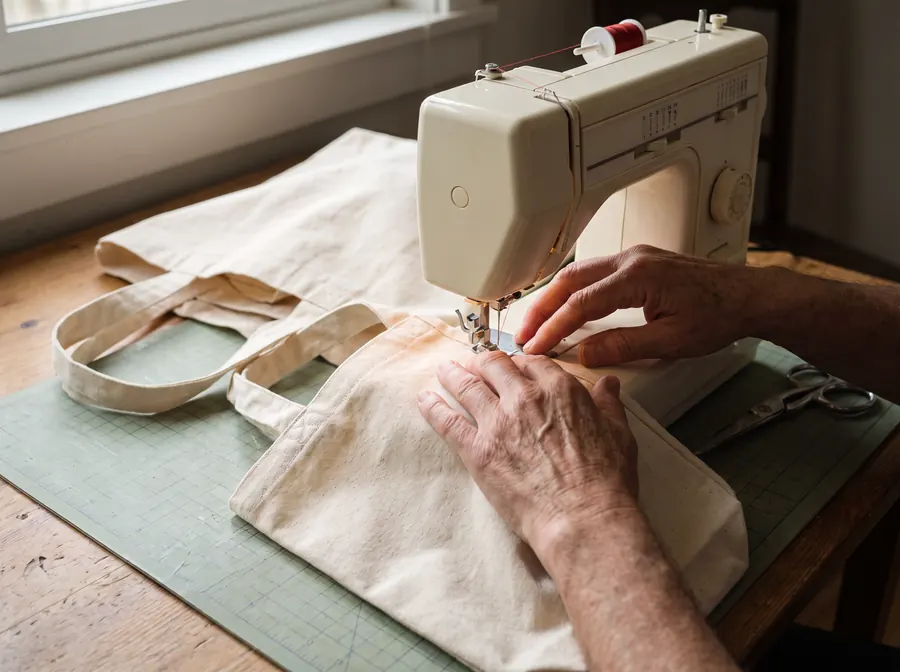
Most “best sewing machine” lists rank a handful of models, and models come and go: all three machines we first picked for this guide sold out within weeks. What a beginner really needs is a way to judge any machine in front of them, in a store, online or at a garage sale.
That is why the three picks above come with a guide: the features that make learning easier, the marketing to ignore, a ten-minute test you can do before you buy, and what to check on a used machine. The short answer: buy a simple, sturdy machine from a brand you can get parts and service for, and test it on your own fabric.
What makes the best sewing machine for beginners?
Three things: it sews a good straight and zigzag stitch, it is easy to thread, and you can get it serviced. Everything else is a bonus. Beginner projects like tote bags, cushions and pajama pants use the straight stitch for almost every seam and the zigzag to finish raw edges.
Brands matter less than support. Singer, Brother and Janome appear in almost every beginner guide, but the real question is whether you can buy a bobbin, a presser foot or a repair for your model where you live. Before you buy, search for “[model name] bobbin” and “[model name] manual”. If both turn up easily, that is a good sign.
Which features actually matter?
The table below explains what each common feature does, so you know whether you need it. “Must have” means you will use it on your first projects. “Nice to have” means it makes learning easier but you can live without it.
| Feature | What it does | Verdict |
|---|---|---|
| Straight and zigzag stitch | Sews seams and finishes edges so they do not fray | Must have |
| Adjustable stitch length | Long stitches for gathering and basting, short ones for strong seams | Must have |
| Reverse lever or button | Sews backward a few stitches to lock the start and end of a seam | Must have |
| Free arm | Part of the base slides off, so sleeves and pant legs fit around the arm | Must have for clothes |
| Buttonhole, one-step | A special foot holds the button and the machine sews the buttonhole to fit | Nice to have |
| Buttonhole, four-step | You turn the dial through four stages by hand; works fine, just slower | Fine instead of one-step |
| Drop-in bobbin | Bobbin drops in from the top under a clear cover, so you can see when thread runs low | Nice to have |
| Automatic needle threader | A small hook pulls the thread through the eye of the needle | Nice to have |
| Speed control slider | Caps the top speed, so a heavy foot on the pedal cannot run away from you | Very helpful for nervous starters |
| Needle up/down | Stops with the needle in the fabric, so you can turn corners neatly | Nice to have |
| Adjustable presser foot pressure | Lets you sew thick or slippery fabric more evenly | Later |
| Hundreds of decorative stitches | Fancy borders and patterns | Skip for now |
Front-loading bobbins (the bobbin sits in a small case you insert from the front, behind a little door) are not a dealbreaker. Many good machines use them. They take a few tries to learn, and you cannot see the thread level without opening the door.
Mechanical or computerized: which is better for a beginner?
Both work. Choose mechanical if you want simple and easy to repair, computerized if you want speed control and needle up/down built in. A mechanical machine uses dials and a lever: you turn a dial to choose the stitch and another to set length and width. A computerized machine uses buttons and a small screen, and often adds a start/stop button, so you can sew without the foot pedal.
Many sewing guides lean toward mechanical machines for a first machine, because they have fewer parts that can fail and are often easier for a technician to fix. Some dealers recommend computerized machines instead, for their ease of use. Use this rule instead:
- You mostly want to sew bags, cushions, simple clothes and mending: a basic mechanical machine is enough.
- You get nervous about speed, or have trouble with fine motor tasks like threading: a computerized machine with speed control (a slider or a slow start/stop mode), a start/stop button and a needle threader is worth it.
- You plan to quilt a lot: look for a needle up/down function and a wider extension table, which is more common on computerized machines. Our quilting machine guide compares three machines for beginner quilters.
What marketing claims should you ignore?
Ignore the stitch count, the word “heavy duty” on its own, and a long list of accessories. These are the claims that make one box look better than the next without telling you how the machine sews.
- “97 stitch applications.” Some brands count every use of a stitch as an “application”, so the number on the box can be much higher than the number of stitches. Even the real stitch count matters little. Look at which stitches it has, not how many.
- “Heavy duty.” This is a product line name, not a standard test. It usually means a stronger motor and a metal frame, which is useful for denim and canvas. Do not assume it will sew anything; test it on several layers of the fabric you plan to use.
- “Includes 10 presser feet.” Extra feet are nice, but a regular foot, a zipper foot and a buttonhole foot cover nearly every beginner project. Check that your machine uses a standard foot type (often called low shank or snap-on), so you can buy more later.
- “Ideal for beginners.” Every box says it. Look at the features in the table above instead.
How do you test a sewing machine before buying?
Sew on it for ten minutes. A sewing shop or dealer will usually let you, and a private seller should too. Bring two scraps of woven cotton and a piece of denim folded into four layers. Then check:
- Threading. Thread the machine yourself using the diagram on the machine. Could you do it again at home?
- Bobbin. Wind a bobbin and put it in. Did it take one try or five?
- Straight seam. Sew 12 inches (30 cm) on two layers of cotton. The stitches should look the same on both sides, with no loops underneath.
- Slow start. Press the pedal gently. Can you sew one stitch at a time, or does it jump forward?
- Thick fabric. Sew over the folded denim slowly. The machine should push through without stalling or skipping.
- Reverse and zigzag. Lock a seam and sew a row of zigzag. Both should be even.
- Noise. A hum is normal. Grinding, knocking or rattling is not.
If you buy online, you cannot test first, so check the return policy and do this test as soon as it arrives.
Is a used sewing machine a good idea for a beginner?
Yes, often, as long as you see it sew first and set aside money for a service. Plenty of good machines get sold after a few uses. The risk is a machine that has sat in a closet for years, or an old model you cannot get parts for.
Checks before you hand over any money:
- It sews. Ask the seller to thread it and sew a line, or do the test above.
- All the parts are there: foot pedal, power cord, bobbin case (on front-loading machines), at least one bobbin and the regular presser foot. Check the pedal cable and power cord for cracks.
- The manual exists. Search for the model number online. If you cannot find a manual or bobbins for it, walk away.
- The needle moves freely. Turn the handwheel toward you by hand. It should turn smoothly, without grinding or sticking.
- Plan a service. Older machines often need cleaning, oiling and a tension check by a technician before they sew well. Your local sewing shop can usually tell you what that costs.
Very old and vintage machines can be lovely, but parts and feet can be hard to find. For a first machine, a model that is still in the manufacturer’s range or only recently discontinued is the safer bet.
Where to go next
Once you have a machine, learn the five skills that make every project work, and start with a simple tote bag. Our guide to starting sewing as a complete beginner covers the supplies and the skills, and the free sewing starter plan walks you through your first project. If you learn better from video, our comparison of beginner sewing courses explains which one fits you; the first pick starts by getting to know your machine.
How we picked
- We did not test these machines ourselves. The picks come from research: each maker's spec sheet, the store's product page and the beginner features in this guide.
- We picked one machine for each of the three situations in the mechanical or computerized section, so you can match a machine to how you plan to sew.
- Each machine had to have the must-have features in the table below: straight and zigzag stitch, adjustable stitch length, reverse and a free arm.
- Prices are the listed price on the check date. We only link stores we have a partnership with, so we earn a commission on all three. Within that store we chose against the features above, not the commission rate.
Read more about how we choose what to recommend.
Questions beginners ask
What is the best sewing machine for a beginner?
The one that fits how you will sew. For bags, cushions and mending on a small budget, a simple machine like the Brother BM3850 is enough. For a machine that lasts and handles thicker fabric, a mechanical one with a foot pressure dial like the Janome Sewist 725S. If speed makes you nervous, a computerized one with a slow start/stop mode like the Juki HZL-LB5020.
Should a beginner buy a mechanical or a computerized machine?
Both work. Choose mechanical if you want simple and easy to repair, computerized if you want speed control and needle up/down built in.
Which features does a first sewing machine need?
Straight and zigzag stitch, adjustable stitch length, a reverse lever or button and a free arm. A drop-in bobbin, needle threader and speed control make the first weeks easier but are not essential.
Does a beginner need a heavy-duty sewing machine?
Not usually. Heavy duty is a product line name, not a standard test. It helps with denim and canvas, but test any machine on several layers of the fabric you plan to sew.
Is a used sewing machine a good idea?
Often, as long as you see it sew first, check that the parts and a manual exist, and budget for a service by a technician.
Want a guided start?
If you prefer learning by watching, this is the beginner sewing course we recommend. Everything you need to begin is also in our free sewing starter plan.
Not affiliate links yet: we have applied to Domestika's program. Your price is the same either way.
Basic Sewing with a Sewing MachineBuy once: unlimited access forever, at your own pace, also on the app. The Domestika Black Friday offer is live: courses at 99% off, bundled with a 30-day Plus trial. You see the current price on the course page before you pay.
Next step: Sewing Machine 101: Make Your First Dress by Juliet Uzor, winner of The Great British Sewing Bee 2019.